


 Back to Search
What can be learned from the 2025 results
The District’s Water Quality Monitoring Program helps track the health of lakes across the region. The long-standing program monitors key indicators, such as phosphorus, calcium and chloride, to better understand long-term trends and help protect Muskoka’s lakes for future generations.
Throughout this release, a sampling site is the specific monitoring location where a water sample is collected, and a lake is the larger body of water in which one or more sampling sites are located.
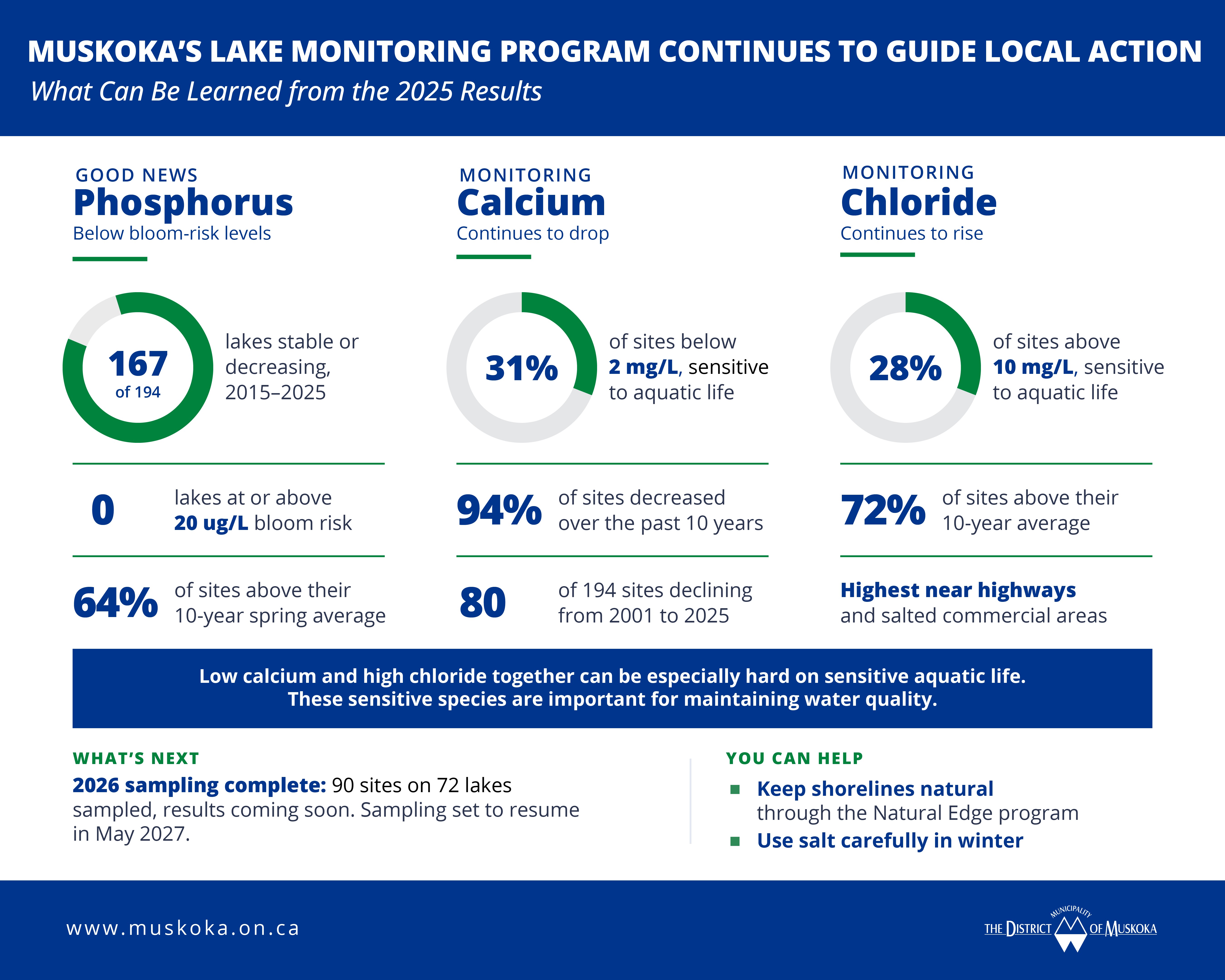
The 2025 results show three key findings: phosphorus levels remain below the threshold associated with bloom risk, calcium levels continue to decline, and chloride levels continue to rise in many lakes.
With financial support through Ontario’s Ministry of Environment, Conservation and Parks, the District’s long-term monitoring helps identify concerns revealed by the annual data and reinforces the importance of maintaining natural shoreline buffers and reducing road salt use where possible to help protect water quality and lake life. Positive trends also highlight the importance of programs like the Natural Edge and Love Your Lake.
“Ongoing monitoring is the foundation of effective lake protection, and we’re fortunate to have strong long-term monitoring data for Muskoka’s lakes,” said Christy Doyle, Director, Environmental Programs. “That information helps the District make informed decisions about emerging issues, respond where pressures are increasing, and continue working with the community to protect the lakes that define this region.”
Phosphorus stays below bloom-risk levels
In 2025, 64 per cent of sampled sites had spring phosphorus levels that were higher than the site’s 10-year average. However, none of the lakes sampled had phosphorus levels at or above 20 micrograms per litre. This threshold is important because algal blooms are more likely to form when phosphorus concentrations exceed this level.
From 2015 to 2025, phosphorus increased in 27 lakes. Levels decreased or remained stable in the remaining 167 lakes. This means the long-term picture remains generally positive, even though some sites recordedhigher-than-average phosphorus levels in 2025. Continued monitoring will help determine whether those higher readings are temporary or part of a long-term change.
Calcium continues to drop
The 2025 results showed an ongoing concern: calcium levels continue to decline in Muskoka’s lakes.
- In 2025, 31 per cent of sites sampled had calcium levels below 2 milligrams per litre. Levels this low can harm sensitive aquatic life. Over the past 10 years, declining calcium levels have been observed at 94 per cent of sites sampled.
- The District’s long-term data matches the 2025 results and confirms that calcium is declining in lakes across Muskoka. For the period from 2001 to 2025, 80 of 194 monitored sites experienced a decreasing trend in calcium concentration. Although calcium decline appears to be slowing in more recent years, many lakes remain below healthy calcium levels.
Chloride continues to rise
Chloride levels are also rising, especially in lakes near highways and commercial areas where road salt is frequently applied.
- In 2025, 28 per cent of sampled sites had chloride levels above 10 milligrams per litre. Levels above this point can harm sensitive aquatic life.
- As well, 72 per cent of sites had chloride levels higher than their 10-year average.
Low calcium and high chloride together can be especially hard on sensitive aquatic life, so tracking these changes helps us better understand how Muskoka’s lakes are changing.
Where do we go from here?
Lake water sampling for 2026 is complete. A total of 90 sites on 72 lakes were sampled The chemical results will be received later this year and will be reported in 2027 in the District’s annual water quality report. 24 sites are sampled annually, so the results from the sites tested annually may clarify the trends discussed above.
The next sampling season is set to begin May 2027.
“Each year, our monitoring program gives us valuable insight into the health of Muskoka’s lakes and helps us make informed decisions about where action is needed most,” said David Zilkey, Manager, Watershed Programs. “The 2025 results continue some encouraging trends, while also reinforcing the importance of advancing stewardship across the watershed.”
Working together: Residents, visitors and property owners all have a role to play in keeping Muskoka’s lakes healthy. Actions such as keeping shorelines natural and using salt carefully in winter can make a real difference over time.
There are simple ways to help protect Muskoka’s lakes:
- The Love Your Lake Program supports lake health assessments.
- The Natural Edge Program helps property owners naturalize their shorelines.
More information about Muskoka’s Water Quality Monitoring Program.
 Subscribe